- The Nature of "the Government" -- Force
- Representative definitions
- Taxation
- Prison/punishment
- War vs. Criminal due process
- "anti-government?"
- trust no one
- McManus/Gow letter
- "privatize" = eschew criminal acts
- Hodge
- Service: A "Well-Governed" Society.
1. The State: The Institutionalization of Violence
The word "government" can be used in different ways.
- Personal responsibility is "self-government."
- We can speak of a "well-governed family."
- The owner of a business imposes a form of government on his employees.
In family, school, neighborhood association, and groups of all kinds, there is "government." When we obey "the Laws of Nature and of Nature's God," our society is orderly, peaceful, harmonious and well-governed. James Madison, "the Father of the Constitution," is reported
to have said,
We have staked the whole future of American civilization, not upon the power of government, far from it. We have staked the future of all of our political institutions upon the capacity of each and all of us to govern ourselves ... according to the Ten Commandments of God.
Every individual and every business and institution created by voluntary associations of individuals is morally obligated to be well-governed, and to respect the rights of others to life, liberty, and property. "Self-government"
creates a society of "Liberty and Justice for all."
What is "THE Government?"
"Self-government" -- following the commandments of God -- is what it means to be human.
But "the government" ("the State") claims the right to seize the property of others by force, have those who resist beaten and raped, and kill all those who get in the way.
"Self-government" is vitrue. "The government" is violence.
George Washington is reported to have said,
Government is not reason, it is not eloquence — it is force. Like fire it is a dangerous servant and a fearful master. . . .
"Private" persons and businesses can only raise money by persuasion. A business can entice a customer to exchange his money for the goods and services produced by the business. A charity can persuade donors to give money voluntarily. But the State raises money through force and threats of violence
Political scientists and scholars in the field of political economy agree with George Washington. The essential feature of "the State" is its use of force to achieve its objectives.
Ludwig von Mises, the most influential political economist of the "Austrian" school of economics, gives us this definition of a "State":
The state is essentially an apparatus of compulsion and coercion. The characteristic feature of its activities is to compel people through the application or the threat of force to behave otherwise than they would like to behave.
Suppose I come up to you and say, "If you murder anyone I'll kill you." I am compelling you through the application or threat of force to behave otherwise than you might like to behave; am I a "State?" Not necessarily; Mises continues his definition:
But not every apparatus of compulsion and coercion is called a state. Only one which is powerful enough to maintain its existence, for some time at least, by its own force is commonly called a state. A gang of robbers, which because of the comparative weakness of its forces has no prospect of successfully resisting for any length of time the forces of
another organization, is not entitled to be called a state. The state will either smash or tolerate a gang. In the first case the gang is not a state because its independence lasts for a short time only; in the second case it is not a state because it does not stand on its own might. The pogrom gangs in Imperial Russia were not a state because they could kill
and plunder only thanks to the connivance of the government.
Consider this question: under Mises' definition, and based on the account in Genesis 14, was Abraham a "State?" It would certainly seem so.
Paul (Romans 13:1) commands us to obey "the powers that be." How does this find expression in Genesis 14? Were there no "powers?" Was Abraham "the powers?" Was it a more complex situation?
Was Abraham fighting "the powers" by fighting the "United Nations Peace-keeping Force," this demonic alliance of kings? It seems clear that in Abraham's life there was no earthly "State" outside of himself, and this situation is acceptable in the eyes of God. (Nevertheless, to advance our thesis, we will never call Abrahamic
Patriarchies "states." "State" will be a term reserved for non-familial or supra-familial systems of social structure.)
"The State" is thus a group of individuals who can steal from and kill a selected target of people without expecting any other group to be willing or able to stop them.
The State is institutionalized, systematic violence.
Every professor of political science in every university on planet earth will agree that the fundamental nature (or most basic definition) of "civil government" (or "the State") is
- an institution of systematic violence
- which maintains a compulsory monopoly of violence.
Proof:
Sociologist Max Weber says
"the State" is "a human community that (successfully) claims the monopoly of the legitimate use of physical force within a given territory."
Mainstream scholarship is summed up in the Encyclopædia Britannica:
State monopoly on violence, in political science and sociology, the concept that the state
alone has the right to use or authorize the use of physical force. It is widely regarded as a defining characteristic of the modern state.
In his lecture “Politics as a Vocation” (1918), the German sociologist Max Weber defines the state as a “human community that
(successfully) claims the monopoly of the legitimate use of physical force within a given territory.” The modern state, according to Weber, emerged by expropriating the means of political organization and domination, including violence, and
by establishing the legitimacy of its rule.
Augustine, in his book City of God, wrote this:
Justice being taken away, then, what are kingdoms but great robberies? For what are robberies themselves, but little kingdoms? The band itself is made up of men; it is ruled by the authority of a prince, it is knit together by the pact of the confederacy; the booty is divided by the law agreed on. If, by the admittance of abandoned men, this evil increases
to such a degree that it holds places, fixes abodes, takes possession of cities, and subdues peoples, it assumes the more plainly the name of a kingdom, because the reality is now manifestly conferred on it, not by the removal of covetousness, but by the addition of impunity. Indeed, that was an apt and true reply which was given to Alexander the Great by a
pirate who had been seized. For when that king had asked the man what he meant by keeping hostile possession of the sea, he answered with bold pride, What you mean by seizing the whole earth; but because I do it with a petty ship, I am called a robber, while you who does it with a great fleet are styled emperor.
The essential point of this Thesis is that God in the Bible nowhere gives any individual or group the right to steal or kill, even if they call themselves "the State." Being a politician does not make taxation less theft, or war
less murder.
More definitions.
3. Taxation
When a business in the "free market" needs to raise money, it must use persuasion to entice the voluntary support of others. By contrast, when "the State" needs money, it takes it by force. This taking is called "taxation." (Other forms of taking, such as fractional reserve banking, asset
forfeiture, and debasement of the currency, are also used. These "revenue enhancement" devices are, like taxation, also immoral.)
It is important to remember that government interference always means either violent action or the threat of such action. The funds that a government spends for whatever purposes are levied by taxation. And taxes are paid because the taxpayers are afraid of offering resistance to the tax gatherers. They
know that any disobedience or resistance is hopeless. As long as this is the state of affairs, the government is able to collect the money that it wants to spend. Government is in the last resort the employment of armed men, of policemen, gendarmes, soldiers, prison guards, and hangmen. The essential feature of government is the enforcement
of its decrees by beating, killing, and imprisoning. Those who are asking for more government interference are asking ultimately for more compulsion and less freedom.
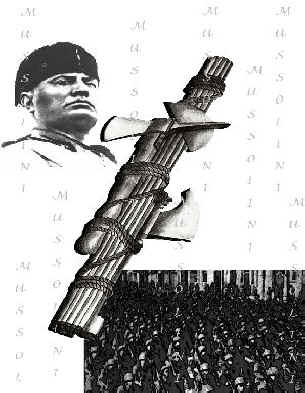
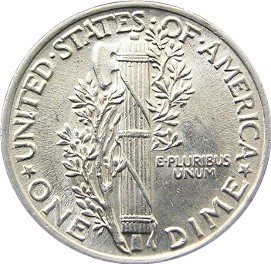
[I]n face of the modern tendencies toward a deification of government and state, it is good to remind ourselves that the old Romans were more realistic in symbolizing the state by a bundle of rods with an ax in the middle than are our contemporaries in ascribing to the state all the attributes of God. |
|
Ludwig von Mises, Human Action, 1949
|
|
|

|
|
"Fasces" from the shield of the
Partito Nazionale Fascista
|
|
|
|
The Fasces: Weapon of Political Thugs
see fascism
|
|
"New Deal" fasces,
Mercury Dime
|
|
4. Prison/punishment
When the target refuses to "contribute" its money to "the State," the target is threatened with prison. Such threats are calculated to create "voluntary compliance."
"There Oughta Be a Law!"
Actually there already is a Law. The Declaration of Independence speaks of "the Laws of Nature and of Nature's God."
- When someone says
- "There ought to be a law!"
- he really means
- "There ought to be government action
-- there ought to be vengeance --
there ought to be misery and pain inflicted on the person who offended me!"
Suppose Jones wants some extra money. He asks Smith for some money and Smith refuses. Jones threatens to lock Smith up in the Jones Basement for five years with a violent sociopath, who will beat and rape Smith every day for the next five years. Smith pays up. That this form of coercion is at the heart of the State's "criminal justice system" is seen
in this opinion from the Los Angeles Times in June of last year (before any allegations of cooked-books or any other illegal conduct had been made against Enron):
Here's what California Atty. Gen. Bill Lockyer said at a press conference about Enron Corp. Chairman Kenneth Lay: "I would love to personally escort Lay to an 8-by-10 cell that he could share with a tattooed dude who says, 'Hi, my name is Spike, honey.'"
Here's why Lockyer should be removed from his office of public trust: First, because as the chief law enforcement officer of the largest state in the nation, he not only has admitted that rape is a regular feature of the state's prison system, but also that he considers rape a part of the punishment he can
inflict on others.
Second, because he has publicly stated that he would like to personally arrange the rape of a Texas businessman who has not even been charged with any illegal behavior.
Lockyer's remarks reveal him to be an authoritarian thug, someone wholly unsuited to holding an office of public trust.
But his remarks do have one positive merit: They tell us what criminal penalties really entail.
Contrary to some depictions of prisons as country clubs, they are violent and terrible places.
Tom G. Palmer,
'Hi, My Name Isn't Justice, Honey,' and Shame on Lockyer,
L.A. Times, Wednesday, June 6, 2001 || more
|
|
"The State" is "a violent and terrible" idea.
5. "War" vs. Criminal Due Process
The State claims the right to kill. The State is symbolized by the sword for this reason.
- If Smith resists the confiscation of his property, and then resists his own imprisonment, the State will kill him.
- If Smith is not a citizen of "the State" in question, the State will label him an "enemy combatant" and will kill him.
- Sometimes even citizens are killed as part of a "war on drugs" or "war on terrorism."
Ted Rall Online - "George W. Bush, Warlord"
Osama bin Laden was accused of conspiring to vandalize the World Trade Center and murder its occupants. Instead of being pursued by law enforcement agents, in accord with Constitutional procedures, the power of "the sword" was invoked. War does not observe constitutional limitations. Thousands of non-combatant Afghanis were killed in "the war on
terrorism."
6. Is this an "anti-government" attitude?
- a. "Trust No One" -- An American Ethos
-
- How do libertarians respond to the accusation that they do not have enough trust in government? John Adams wrote in 1772:
There is danger from all men. The only maxim of a free government ought to be to trust no man living with power to endanger the public liberty."
Should libertarians have more confidence in their government? Thomas Jefferson, 1799:
Confidence is everywhere the parent of despotism. Free government is founded in jealousy, and not in confidence; it is jealousy, and not confidence, which prescribes limited constitutions to bind down those whom we are obliged to trust with power.… In questions of power, then, let no more be heard of confidence in man, but
bind him down from mischief by the chains of the Constitution.
James Madison warned the people of Virginia (1799):
the nation which reposes on the pillow of political confidence, will sooner or later end its political existence in a deadly lethargy.
Madison added in Federalist No. 55,
[T]here is a degree of depravity in mankind which requires a certain degree of circumspection and distrust. . . .
Trusting government, having "confidence in government," is un-American.
The British historian Lord Acton put it this way:
Power tends to corrupt and absolute power corrupts absolutely. Great men are almost always bad men, even when they exercise influence and not authority; still more when you superadd the tendency or the certainty of corruption by authority. There is no worse heresy than that the office
sanctifies the holder of it.
The exercise of political power is problematic. We should assume that "great men" -- that is, powerful men -- men who wield the force of "the government" -- are morally corrupt. This assumption should be considered confirmed if he increases his own power during his time of "public service."
- b. McManus/Gow letter
-
- c. Religion as "Private" = failure of public criticism of criminal acts by the State
-
- In the modern world, the State claims to be "neutral" with respect to religion. "Religion" is said to be "private." It is religion that says "Thou shalt not steal," and so by privatizing religion, the State avoids criticism based on its violation of Divine Law. Requiring the State to be "under God" is
derided as "imposing religion on others," or violating a mythical "separation of church and state." Criticizing the State based on religion is (conveniently) undignified and inappropriate.
- 1. "The Laws of Nature and of Nature's God."
- 2. The Myth of "Private Religion"
-
- d. Hodge: Moral Revulsion
- This thesis is not rooted in hedonism or antinomianism. Our desire to abolish the State is motivated by the fact that (to adapt the words of Princeton professor A.A. Hodge in 1887) the State is
the most appalling enginery for the propagation of anti-Christian and atheistic unbelief, and of anti-social nihilistic ethics, individual, social and political, which this sin-rent world has ever seen.
In particular, the State engages in more theft, murder, and kidnapping than any other group of people, including the criminals from which the State promises to protect us. The State is, without close competition, the greatest thief and mass murderer on the planet. The 20th century, marked by the final destruction of Christian localism and the rise of the
secular State, has been the century of mass death on a scale unparalleled in human history.
A.A. Hodge, Popular Lectures on Theological Themes, Phila: Presbyterian Board of Publications, 1887, p. 280, quoted in R.J. Rushdoony, The Messianic Character of American Education,
Nutley, NJ: The Craig Press, 1963, p. 335. Hodge was referring to the government-run school. But all of government, as propagator of law, is an educator. See R. Lerner, “The Supreme Court as Republican Schoolmaster,” 1967 Sup.
Ct. Rev. 127. Legal systems educate
the masses. They set the agenda for private citizens (see "private religion," above)
7. Service: A "Well-Governed" Society
There are several features of a well-governed society. All of them require attitudes of service. None of them require theft, violence, or threats of force.
- The Education of Children
- Employment and Vocational Training
- The Care of the Elderly
- Care of the Fatherless
- Care of the Ill and Handicapped
- Freedom of Conscience
Service
A well-governed person, who yearns for a well-governed society, wants to place firm limits on "the government."
But can there be too many limits on "the government?" What if the chains of the Constitution strangle "the government" or "the government" is abolished all together?
I believe this would be a good thing.
"But wouldn't that be anarchy?" some might ask.
If you equate "anarchy" with "lawlessness." then "anarchy" is a bad thing. But if you understand that "anarchy" means "the absence of archists," then your next question should be, "What is an archist?" Keep reading on this page if you want to learn more about "law" and
"lawlessness," or click the link below to find out why good and moral people are against "archists."
Free Market Dispute Resolution Organizations
The Nature of Government
What is the "State"?
The State as Criminal
Order without Violence